Delaware County Courthouse

The former Delaware County Courthouse in Muncie, Indiana, was the county's third courthouse, built in 1887 by Fort Wayne architect Brentwood Tolan in a French Renaissance style. It was designed as a landmark Beaux-Arts sandstone structure with a prominent clock-tower dome and multiple ornate entrances, symbolizing Muncie’s prosperity, and civic pride. The courthouse served as the center of county government and a focal point for public gatherings for nearly a century.
The old Delaware County Courthouse was famous not just for its civic role but for its richly detailed architecture: a soaring clock tower with a historic bell, grand arched entrances, carved stone ornamentation, and broad limestone staircases that once led up to the courthouse terraces. These features made the building a dramatic centerpiece of the square. Much of that sculptural decoration survived demolition, including four large allegorical figures (often identified as Native American chiefs, “Agriculture,” and “Industry”) some of which were carved in the 1880s by sculptor John A. Ward. Those salvaged sculptures were later set aside from the demolished building, and after periods in storage, and on display elsewhere, were sited on the northwest corner of the present courthouse square, where they still stand today.
Over the years, the Delaware County Courthouse in Muncie, Indiana, drew several nationally known political figures, including John F. Kennedy. On October 5, 1960, while campaigning for the presidency, Kennedy spoke on the courthouse lawn in front of thousands of voters. This and numerous prominent visits reflect the courthouse square’s long-standing role as a hub of civic and political life for the community.
The courthouse was demolished in 1966 for a combination of practical and symbolic reasons. By the mid-20th century, the building had become overcrowded, inadequately ventilated, and structurally worn. It was serving far more people than it was designed for, and its interior layout, including unusually wide bearing walls, made modernization difficult or impossible. Additionally, with issues like neglect and deterioration, the old courthouse was torn down as part of what was seen as civic renewal and modernization.
For more information, visit https://dmr.bsu.edu/digital/collection/DlwrCtyCrtH/
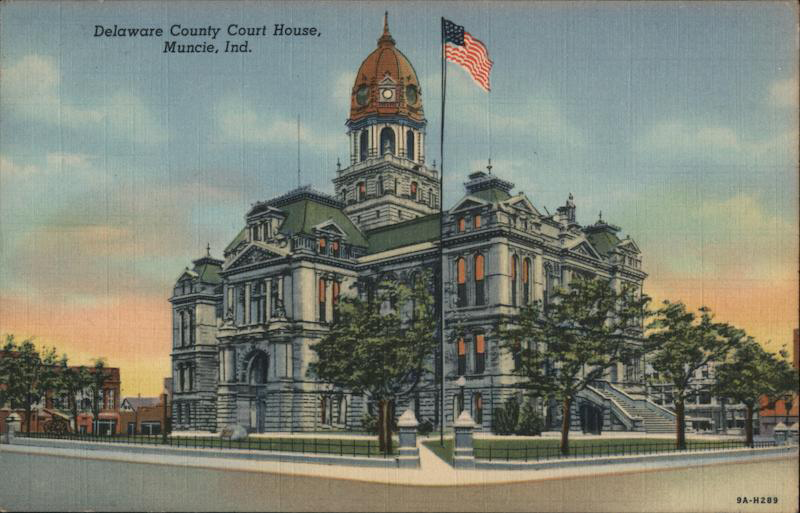 Digital Media Repository. Ball State University Libraries.
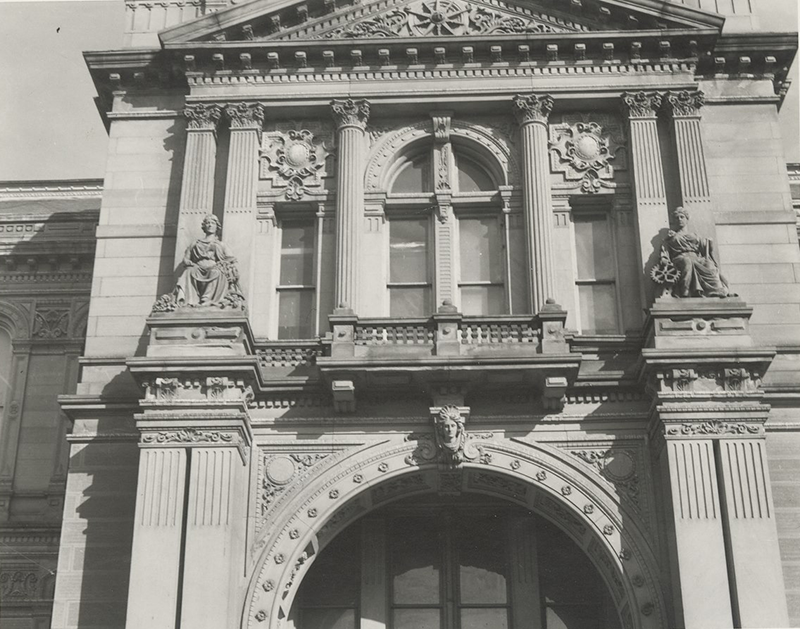 Digital Media Repository. Ball State University Libraries.
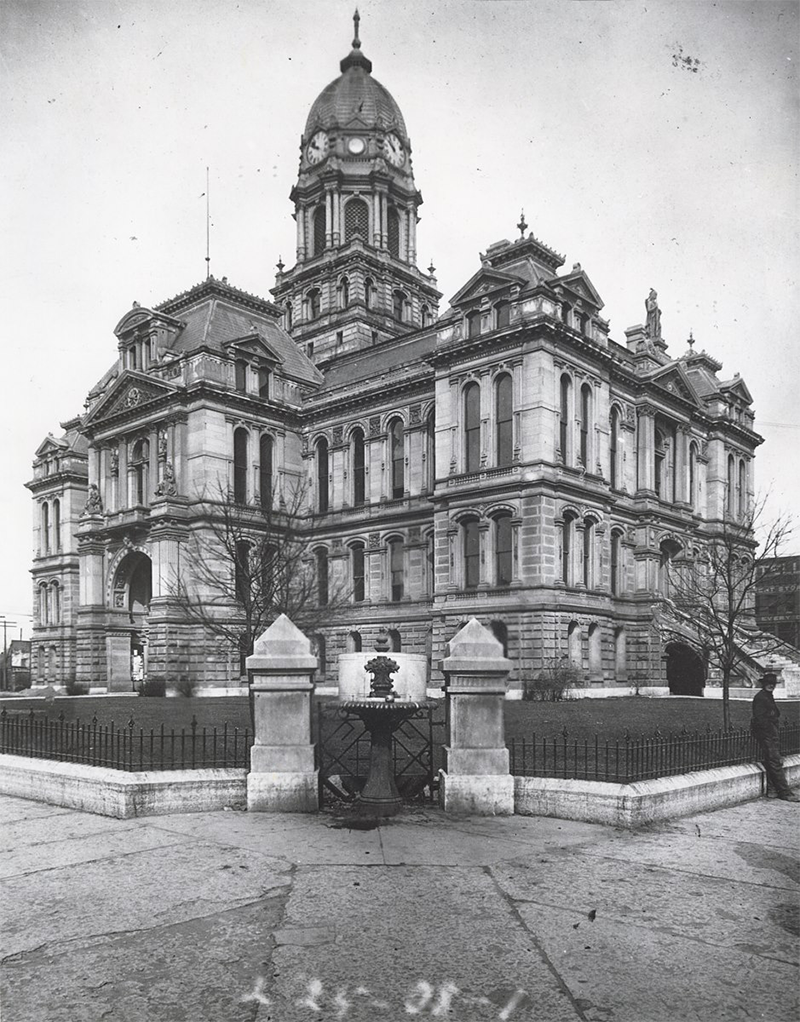 Digital Media Repository. Ball State University Libraries.